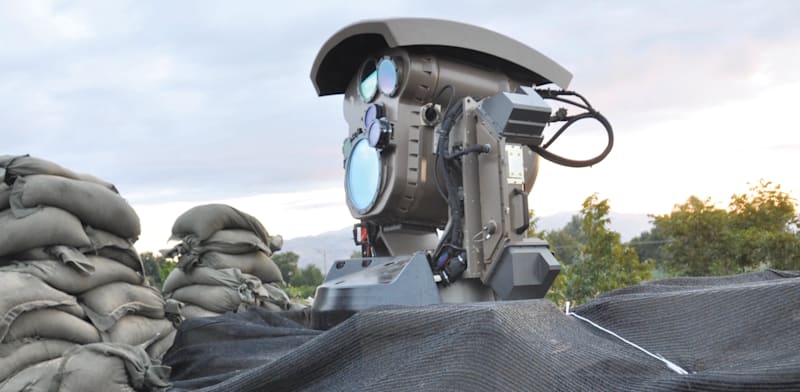
The Iron Beam high-energy laser air defense system was meant to provide a robust solution to the threats from UAVs and drones in Israel’s northern skies. In practice, since Hezbollah joined the current round of fighting, dozens of unmanned aircraft have penetrated the border. Just in Kiryat Shemona and Kibbutz Dafna there have been eighteen UAV warnings, and some of these aircraft flew around undisturbed until they were shot down by conventional means, fired at from helicopters or even with assault rifles.
This state of affairs raises questions, especially given that the laser system carried out successful interceptions in the Northern Arrows operation in 2024. It completed the trials stage in 2025, was declared operational at the end of the year, and initial units have been delivered to the IDF.
As far as is known, the IDF has only a small number of laser systems at present. Negligible use has been made of them in the current campaign, and the IDF spokesperson has refused to comment on their contribution to the fighting in the north. The lack of clarity on the matter has spawned fake news: at the beginning of the operation a forged video clip was distributed on social networks showing a laser beam knocking out missile salvoes one after another. The reality is that the system is not designed to deal with ballistic missiles and, contrary to what appears in the video, the laser beam is not visible from a distance.
Interception costing a few shekels?
The disappointing facts contrast with the high expectations of the system, and the billions of shekels invested in it. In late 2024, the Ministry of Defense, Rafael (the designer of the system) and Elbit (its developer) signed a NIS 2 billion deal for expansion of production and procurement of the system. The original plan was to integrate the laser with the Iron Dome system, such that preference would be given to the laser to deal with any low altitude threat, but plans are one thing and performance is another.
Rafael chairperson Yuval Steinitz promised in the past that the laser system would make it possible to carry out interceptions at a cost of just a few shekels, and that it would even provide an answer to rockets and missiles. At present, however, the system is limited to dealing with UAVs and drones only, and even in that respect it has underperformed. Moreover, although the cost of “pulling the trigger” is indeed low, each laser interception system costs tens of millions of shekels. Creating an effective protective layer along the northern border requires further investment of billions of shekels, a budget that has not yet been allocated.
RELATED ARTICLES
Iron Beam laser defense system delivered to IDF
Between euphoria and reality
Brig. General (res.) Ran Kochav, a former commander of the Air and Missile Defense Forces who is now a research fellow at the Royal United Services Institute in London told “Globes”: “There is no doubt that we are taking about a most impressive technological breakthrough. The laser could be the next promising technology as a complementary system in the lowest layer, a real additional technological factor like another Iron Dome launcher, but all the same, the expectations that have been built up are exaggerated. The expectation has been created that it will solve the air defense problem, and that really is not the case.”
Kochav says that the system is still in its infancy. “It fires at very short ranges, is sensitive to climatic conditions such as fog, dust storms, and clouds, and is relevant only against drones and UAVs – certainly not against rockets or threats from Iran. Rafael chairman Steinitz talks about interceptions costing the price of a tin of cola – perhaps, but in order for it to be that effective it’s necessary to invest billions of shekels and to deploy it along all the borders. The euphoria has to adjust to reality.”
Limitations of laser beams
Kochav says that the current war, on the evidence of what is happening in the Gulf states and also in Israel, demonstrates that technological progress and procurement in the area of miniature unmanned aircraft in Hezbollah and Iran is faster than laser development, just as in the Russia-Ukraine war.
“The UAVs highlight a gap in our defense system, and in contrast to active defense – interception by means of Arrow missiles or Iron Dome – where the success rate is estimated at 90%, at present there is no ultimate defensive solution to these miniature aircraft, most of which are currently shot down by kinetic means, interceptors and shells, and certainly not by lasers.”
The Iron Beam system is based on a 100 kilowatt laser beam that is focused on the target for several seconds until it causes structural failure and brings it down. Because of the fairly low power, the system is effective against light and slow objects, but cannot deal with fast moving ballistic missiles such as those of Iran or Hezbollah’s “Fateh” missile.
Dr. Yehoshua Kalisky, a senior researcher at INSS (the Institute for National Security Studies), explains that “in the US they developed chemical laser systems that produced one megawatt, ten times the power of the Iron Beam laser, but the project was halted because of budgetary considerations. Today, the Americans are trying to upgrade the solid-state technology, similar to ours, to an output of 500 kilowatts. It may be that under strategic agreements between Israel and the US we will be able to benefit from it.”
The main problem with this technology, however, is physical. “The laser is only 30% efficient. 70% of the energy becomes heat. The more the output is increased, the larger and more complex are the means required of dispersing heat, and that becomes a real engineering problem,” Kalisky says.
“The many engineering challenges prevent the laser system becoming at this stage a mass interception system like Iron Dome. It doesn’t work well in difficult weather conditions and struggles to deal with swarms of UAVs because of the fact that it works in series and can only deal with one target at any given moment. At present, to shoot down a whole swarm, you need many systems working in coordination.”
Dr. Kalisky believes that solutions to these limitations will be achieved with extensive research and development. “To overcome atmospheric distortions simulations can be carried out that correct the way the beam works in real time. The serial fire problem can be solved by increasing the beam’s output: as power increases, the amount of time required for dealing with each target will shorten considerably, and the system will be able to jump quickly between targets and neutralize swarms efficiently.”
The IDF stated in response: “The Iron Beam system is at the stage of being accepted into the Air Force. At the same time, other systems are being developed and produced, in accordance with the work plan that has been expedited in view of the security challenges. We are unable to provide details on the way systems are operated.”
Published by Globes, Israel business news – en.globes.co.il – on March 11, 2026.
© Copyright of Globes Publisher Itonut (1983) Ltd., 2026.
#happened #Iron #Beam