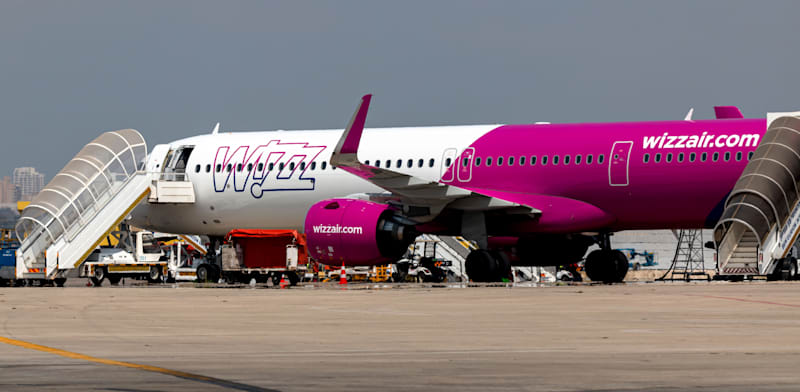
In the weeks before the war with Iran began, there were heated discussions on Wizz Air setting up a hub in Israel. The Ministry of Transport was conducting negotiations with the Hungarian low-cost airline, while Israeli airlines and workers committees were staunchly opposed and had already declared a labor dispute and a strike at Ben Gurion Airport over the matter was even on the agenda.
With the outbreak of war, the local aviation industry put differences aside and worked together to rescue over 100,000 Israelis stranded abroad. The war has also put the issue of operating flights to Israel during an emergency, which was a bone of contention in Israel’s negotiations with Wizz Air, which has suspended flights from Israel until at least March 29, back on the agenda.
The EU regulator
The Ministry of Transport had set Wizz Air’s operations in Israel during emergencies as a key condition. But for a European airline subject to the EU’s aviation regulator EASA, this is a complex issue, since as long as EASA instructs carriers not fly to Israel, even operations with Israeli crews would not allow it to continue operating here.
As of now, an Israel Civil Aviation Authority NOTAM (change or restriction in airspace, for example, closing an area to flights, safety hazard or temporary restrictions at an airport) has been imposed on the area, but even when it is lifted, this issue is expected to remain one of the main points of contention surrounding the establishment of Wizz Air’s hub.
Pilots of foreign airlines are also required to undergo special certification in order to land in Israel during an emergency, which Wizz Air pilots do not hold. However, alongside the NOTAM issued by Israel, these are restrictions that depend on the Israeli authorities and can be regulated.
The Ministry of Transport believes that it will be possible to find a solution to the issue of the EU regulator, which could even grant an exception for Wizz Air. Meanwhile, in times of emergency, when capacity at Ben Gurion Airport is very limited, the option of flying via neighboring countries provides a partial solution.
Thus, while Israeli airlines cannot land at airports in neighboring countries with Israeli aircraft, but only via chartered aircraft, Wizz Air can operate its own aircraft in countries like Egypt.
Wizz Air CEO Jozsef Varadi addressed the issue of flights during times of emergency in Israel last November: “We are a European company and therefore are limited by European regulation,” but added, “as soon as we have a more substantial presence in Israel, we will receive more information and security briefings, and thus we will be able to make more decisions ourselves.”
The conflict that interrupted the campaign
RELATED ARTICLES
Israir CEO: We are not profiting from the situation
El Al unveils rescue flight fares
Wizz Air operating Sinai flights to rescue stranded Israelis
On the possibility of establishing a Wizz Air hub in Israel, it is clear that the main reason for the opposition was concern that the European airline would enjoy benefits similar to those of Israeli airlines, primarily receiving early morning slots, which would allow better utilization of their planes and more flight rounds per day.
At the same time, according to Israeli airlines, Wizz Air would not be required to bear all the costs imposed on them. Establishing a Wizz Air hub in Israel could set a precedent that would attract other foreign airlines to consider a similar move. From the Israeli airlines point of view, this would involve competition with large players that do not pay taxes in Israel and are not subject to the same regulatory, security and operational requirements. In such a situation, the industry warns, smaller companies could be gradually wiped out, and even larger carriers like El Al could also be harmed.
The battle for every slot
The same problem that limits Wizz Air in times of emergency is also faced by Israeli airlines that operate chartered aircraft. Arkia, for example, has a chartered wide-body aircraft that cannot currently evacuate passengers from East Asia or the US to Israel, and therefore this is done via intermediate airports such as Athens and Sharm el-Sheikh.
In practice, the Home Front Command’s guidelines do not allow for a prolonged stay of passengers at Ben Gurion Airport, which particularly affects the operation of wide-body aircraft, which are currently limited in their ability to land at Ben Gurion Airport, as only one wide-body aircraft can be brought in per hour. El Al, which has the largest fleet of wide-body aircraft, is dealing with the limitation of having the highest number of passengers stranded abroad – about 18,000, thousands of them at long-haul destinations, the evacuation of which requires the use of wide-body aircraft. This means: a battle for every landing slot.
As long as the frequency of landings is not increased and the Home Front Command’s guidelines are not eased, the slow pace of evacuation will continue to lengthen the waiting times of Israelis abroad. Following the growing pressure, a plan is currently being formed that will give priority to wide-body aircraft in the allocation of slots, in order to speed up the evacuation of passengers from distant destinations. However, according to industry sources, this is a move that comes a little too late. Either way, Wizz Air’s absence from the skies over Israel now clearly illustrates the heart of the debate surrounding the establishment of the hub: to what extent can a foreign company be a permanent player in the local market, if in moments of crisis it cannot necessarily operate there.
Published by Globes, Israel business news – en.globes.co.il – on March 12, 2026.
© Copyright of Globes Publisher Itonut (1983) Ltd., 2026.
#War #exposes #Wizz #Airs #Achilles #heel #Israel #hub