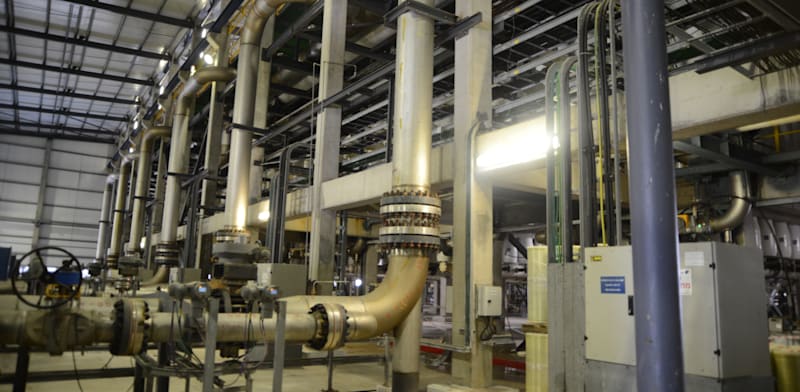
Since late August, microscopic algae from the Nile have been clogging up Israel’s desalination plants, which supply nearly 80% of the country’s domestic and municipal water needs, forcing the temporary shutdown of five of the country’s six major facilities. While the plants were offline, the necessary water supplies were drawn entirely from groundwater and the Kinneret (Sea of Galilee,) both of which are already in a precarious state.
The algae-induced turbidity now seems to be naturally dwindling, allowing some of the desalination plants to resume full-capacity operations. However, this incident has highlighted the severity of Israel’s water situation. The last two winters were particularly challenging for the country’s water sector. Even the most recent winter, which was not statistically a drought year, failed to deliver sufficient rainfall over the Kinneret and its drainage basin. Consequently, the lake’s water level dropped to minus 213.5 meters below the “red line” – the lowest level recorded since 2018.
Groundwater levels in Israel are also critically low, sitting roughly 1.9 meters above the red line, compared with about 5.3 meters above it in 2024. Between 2024 and 2025, groundwater levels fell at their fastest rate in at least 25 years, with a drop of nearly 2.5 meters in a single year. Dropping below the red line creates a risk of chemical changes in the water’s composition, so great effort is made to avoid reaching that point. If the coming winter does not bring sufficient rainfall, Israel could find itself facing a problem.
The State Comptroller has already raised the alarm
The Kinneret and Israel’s groundwater reserves effectively serve as the country’s water “savings account,” given that in recent years, the vast majority of water for domestic and municipal use has been supplied through ongoing desalination. Agricultural water needs are met primarily by reclaimed wastewater (effluent). This shift stems from past years of drought and water scarcity, most notably 2009-2010, which prompted the “Israel is Drying Up” public information campaign.
However, despite these efforts, there have been protracted delays in the construction of new desalination plants. The contract for the major Sorek 2 plant was awarded in 2020, but events such as the Covid pandemic and the war have delayed the project by two and a half years. Every cubic meter of water that is not routinely desalinated is drawn from Israel’s groundwater and Kinneret reserves. When desalination fails, as it has done due to the algae incident, these reserves are found to be severely depleted.
RELATED ARTICLES
Water supply hit as 5 desalination plants shut down
While it appears, that the turbidity caused by the flourishing Nile algae in the Mediterranean is beginning to recede, it remains unclear how long it will take for all desalination plants to return to full capacity. The State Comptroller already warned in 2024, “The Ministry of Health had not yet conducted the survey it deemed necessary regarding algal toxins and other toxins released into the water by invasive species due to the climate crisis.” That very scenario has now materialized.
During the first 24 hours of the crisis, there were disruptions to the water supply (primarily affecting agriculture, leading to demands for compensation). However, the water supply subsequently normalized, and no one found their tap running dry.
Farmers will pay the price
Mekorot, the national water company which is responsible for the day-to-day operation of Israel’s water reserves, has already rehearsed a scenario in which a cyberattack disables five out of six desalination plants. That is precisely what happened, though the culprit turned out to be microscopic algae with no geopolitical ambitions.
The greater challenge lies in the long term. The need to draw on water from groundwater sources and the Sea of Galilee during emergencies comes at a time when these sources are in a particularly precarious state. Water sector professionals are hoping for a rainy winter with well-distributed precipitation, which would allow for infiltration and the replenishment of groundwater aquifers but there are no guarantees. A campaign encouraging water conservation is expected to launch soon. Should these measures fail, Israel’s “third line of defense” for its water supply is agricultural water consumption.
Agricultural water consumption accounts for the majority of water use in Israel (about 1.4 out of 2.4 billion cubic meters annually). Yet it is considered relatively efficient because most of the supply comes from treated and reclaimed wastewater rather than potable fresh water. However, the infrastructure for delivering this water, which is sold at a particularly low price, does not reach all farmers, and some continue to purchase potable fresh water. The Israel Water Authority has recently been pushing for increased investment in pipelines to transport treated wastewater to additional regions of the country, enabling farmers to disconnect from the fresh water supply that serves households.
In any case, this situation has sparked controversy on the relatively low price at which farmers buy water. The price difference amounts to an annual subsidy of NIS 300-350 compared with the rates paid by domestic consumers. Should another dry winter occur, or if issues arise with water desalination, farmers could face cuts to this subsidy and a reduction in their subsidized water quotas.
Published by Globes, Israel business news – en.globes.co.il – on September 24, 2026.
© Copyright of Globes Publisher Itonut (1983) Ltd., 2026.
#Desalination #plant #shutdown #exposes #precarious #reserves