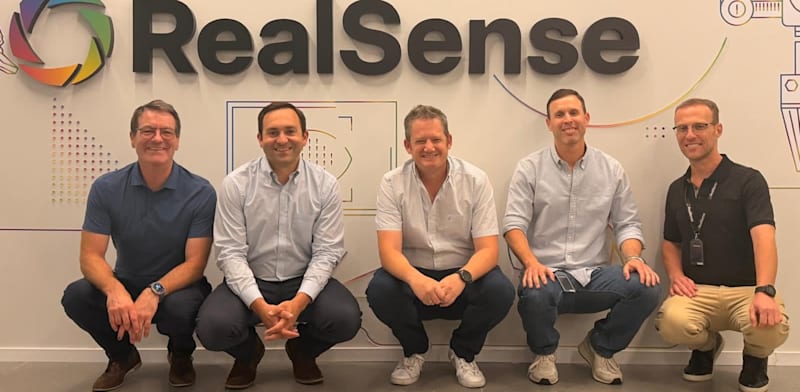
US machine vision and barcodes solutions company Cognex Corp. (Nasdaq: CGNX) has announced the acquisition of Israeli depth cameras and computer-vision systems company RealSense for over $600 million. Cognex will pay $500 million cash plus $56.5 million in a three-year $56.5 cash retention program at target for employees, subject to performance milestones, and $50 million in restricted stock units.
This represents a 500% return for Taiwanese investors and Intel Capital on an investment made just 14 months ago. Last year, shareholders invested $50 million based on a company valuation of only $102 million.
As part of the deal, Cognex is expected to allocate a compensation package to the company’s employees, comprising stock, cash, and options, totaling $106 million. It is estimated that at least 80 of the company’s employees in Israel will receive over NIS 1 million each. The company currently has 180 employees, 140 of whom are based in Israel, including 110 employees who came from Intel.
RealSense was spun off from Intel two years ago as a loss-making company generating quarterly revenues of $7-8 million (or $30-40 million annually). By the end of 2026, the company is projected to record revenue of $80-90 million and is estimated to be profitable, which contributed to Cognex’s decision to acquire it and turn it into an independent division.
RealSense was Intel’s 3D vision innovation division when it was on the verge of closure. At the time in 2024, Intel was in the eye of the storm: CEO Pat Gelsinger was fighting for the company’s survival amid mounting losses, growing public criticism, and rounds of layoffs and cutbacks that affected every one of the company’s product lines. Gelsinger favored selling off or shutting down any operations outside the company’s core business, such as the shift toward manufacturing chips for other companies. This strategy led to the closure of Granulate, an Israeli startup that developed cloud management software, which Intel had acquired in 2022 for $650 million.
The RealSense innovation lab, led by Israeli executive Nadav Orbach, was also slated for closure. However, Orbach and his team – in consultation with Gelsinger- decided to spin off the unit and sell it to a private investor group. Intel itself participated in this group through its venture capital fund dedicated to startup investments.
In July 2025, RealSense raised $50 million as an independent startup in a round led by an unnamed Taiwanese venture capital fund, alongside Intel Capital, the Taiwanese chip giant MediaTek, and the German security company Dormakaba. Since then, it has signed a partnership with Nvidia and become one of the leading vision sensor manufacturers in the robotics market, capturing over half the market share for humanoid robots, high-end industrial robots, and robotic arms.
“Producing the world’s leading 3D perception layer”
In just 18 months, RealSense has become a success story, manufacturing and selling 3D cameras to most major robotics companies, with the exception of Tesla, which is betting on 2D cameras paired with algorithms that process the data into 3D vision.
RealSense’s client list includes humanoid robot companies such as Boston Dynamics (now under Korean ownership), the Chinese humanoid giant Unitree, FieldAI, and Enigma, with many of these applications involving robot dogs; warehouse robotics firms like Universal Robots and Locus Robotics (which deploys robots in DHL logistics warehouses) and Symbotic (which manufactures robots for Walmart); companies specializing in robotic arms, such as Inbolt; and agricultural robots, such as those produced by Israel’s Tevel Robotics and Eco Robotics.
Many of these agreements were secured, in part, through close collaboration with Nvidia, which helps distribute RealSense’s solution to its own customer base. According to Orbach, the Israeli company produces the world’s leading 3D perception layer, including in terms of market share. Orbach likens the system to the human cortex: an integrated hardware-software system that connects to cameras from Intel, Nvidia, and Qualcomm and incorporates vision sensors, including infrared, with image processing and analysis capabilities, while Nvidia’s software handles the inference tasks.
RealSense has its roots in an internal Intel initiative from 2010-2011 aimed at entering the 3D perception market. The project was spearheaded by figures such as Roni Friedman (currently outgoing Apple Israel CEO), Mooly Eden-then President of Intel Israel and the initiative’s sponsor, and Sagi Ben-Moshe, an Israeli who became an Intel VP and managed the operation until leaving to found his own camera company. Under the RealSense umbrella, Intel acquired the Israeli company Invision, a competitor to PrimeSense in the early 2010s and US firm Teezix. However, the business unit never achieved profitability during its time at Intel and struggled to launch a product that generated market excitement.
After Ben-Moshe’s departure, Orback, then a senior employee, was transferred to the US to manage the business only to realize, on arriving in New York, that the unit was slated for closure.
“I was sitting on a crate at home when I realized I had come to manage a division that, unknown to me, was scheduled for closure,” Orbach recalled in an interview with *Globes*. “Intel was in a financial tailspin. Before replacing its CEO, the company decided to shut down its innovation division, alongside other operations like Granulate, to focus on core business areas. I met with Gelsinger and explained the business potential inherent in the company [RealSense].”
He told me, ‘If you raise external capital, I’ll back you, and Intel Capital will invest.’ Pat Gelsinger remained a friend, and I raised $53 million. We acquired RealSense as an asset; Intel remained an investor, but we bought out their controlling stake 14 months ago perfectly timed for the boom in robotics. We partnered with Nvidia and entered the fields of humanoid robots, robotic dogs, and autonomous vehicles.”
Published by Globes, Israel business news – en.globes.co.il – on September 22, 2026.
© Copyright of Globes Publisher Itonut (1983) Ltd., 2026.
#Cognex #buys #Israelbased #RealSense #600m